Around Siem Reap
 Now
that our pass for Angkor Wat has expired, we took the opportunity to
drive around the countryside a little further, to see some of the sights
away from the temples. As long as we're on roads, Mr Heng's tuk-tuk
is quite comfortable, but off road it's definitely a bumpy experience.
The tuk-tuk is basically a trailer that goes on the back of a normal
moped. Sarah and I have a bench seat, while the girls sit on the front
rest, holding onto the roof supports. When its moving, there's plenty
of breeze, and its great for sight-seeing because there's nothing between
you and the world.
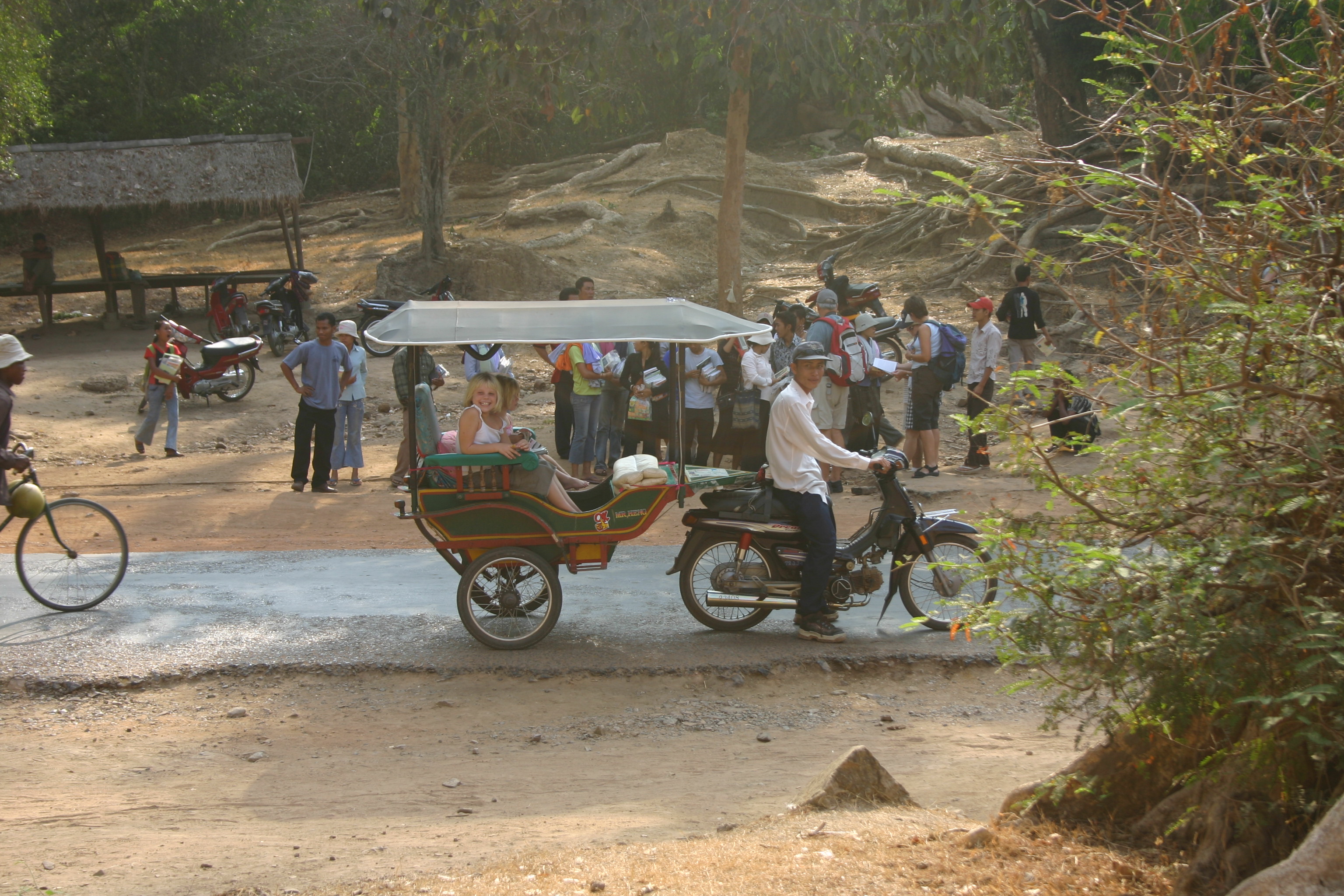
Now
that our pass for Angkor Wat has expired, we took the opportunity to
drive around the countryside a little further, to see some of the sights
away from the temples. As long as we're on roads, Mr Heng's tuk-tuk
is quite comfortable, but off road it's definitely a bumpy experience.
The tuk-tuk is basically a trailer that goes on the back of a normal
moped. Sarah and I have a bench seat, while the girls sit on the front
rest, holding onto the roof supports. When its moving, there's plenty
of breeze, and its great for sight-seeing because there's nothing between
you and the world.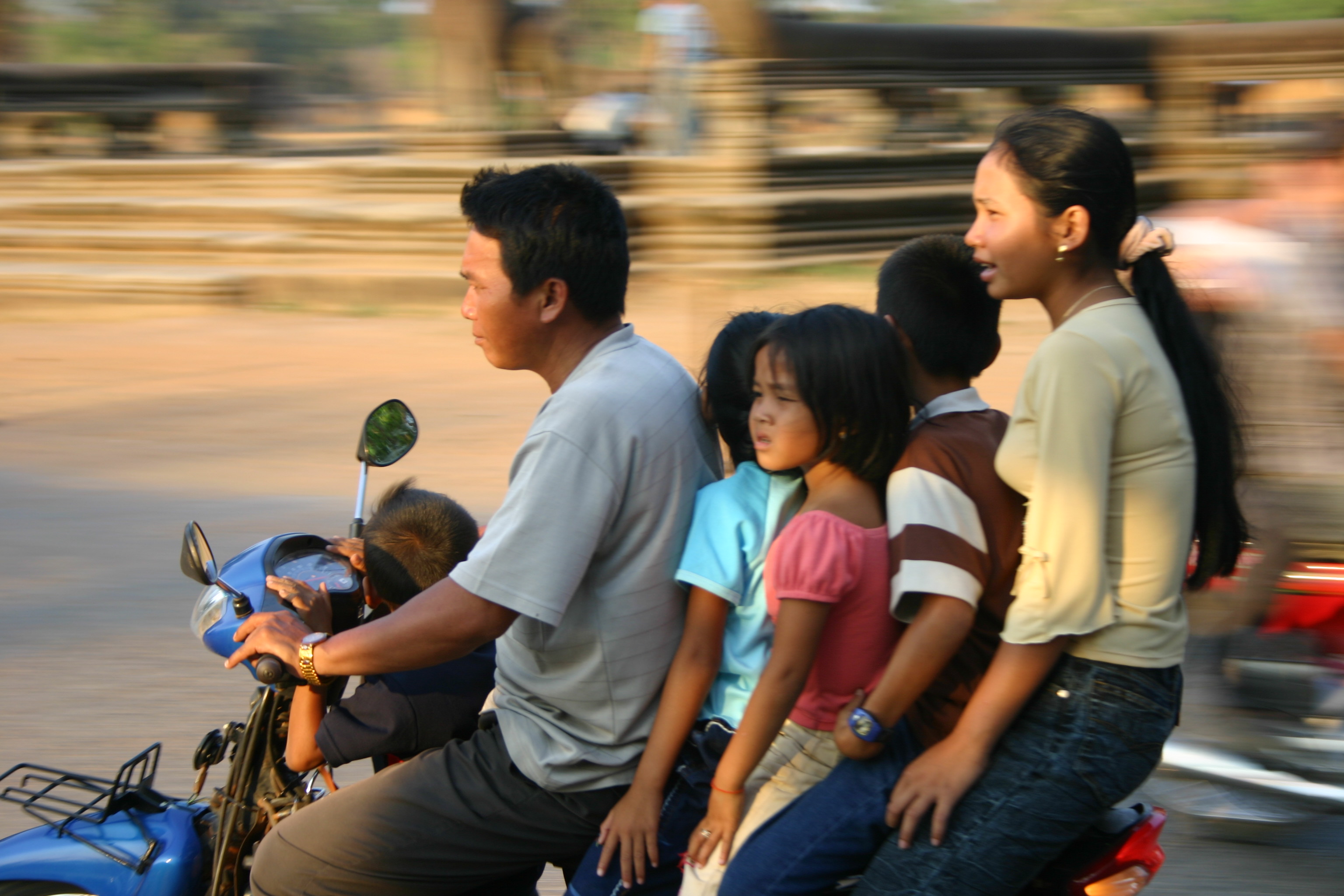 In
Asia, we've noticed that people are very creative with their transport
- the picture on the left is a typical Asian MPV - 6 members of the
same family perched on a single moped whizzing around town. If you click
on the picture you'll see other examples of how people get around -
from squatting on the roofs of lorries, to perching on the bonnets of
trucks, and the contrast of a vintage Rolls Royce outside one of the
grand hotels of Siem Reap, and how a pig is carried to market on a moped.
In
Asia, we've noticed that people are very creative with their transport
- the picture on the left is a typical Asian MPV - 6 members of the
same family perched on a single moped whizzing around town. If you click
on the picture you'll see other examples of how people get around -
from squatting on the roofs of lorries, to perching on the bonnets of
trucks, and the contrast of a vintage Rolls Royce outside one of the
grand hotels of Siem Reap, and how a pig is carried to market on a moped.One of the things that we've been seeing this week is evidence of the 'missing generation' of Cambodia - during the reign of the Khmer Rouge very few children were born in Cambodia, so it is rare to see 25-29 year old Cambodians. In addition the Khmer Rouge systematically tried to wipe out intellectuals, government officials and monks, and even now the country is suffering from the results of that policy - which killed an estimated 2 million people, about a quarter of the population.
Our trip this morning took us past houses built on stilts alongside the river banks. They are very basic huts, and the toilet consists of a bamboo perch over the river. Unfortunately having a bath means bathing in the same river - downstream of everybody else's toilets. Yeuch! Poverty is evident around Cambodia, but even those in jobs receive low wages. A trained, experienced ophthalmologist could expect to earn $70 a month, a typical staff member at a 5-star hotel would earn $100 a month, and a tuk-tuk driver would typically earn $3-5 a day (which could go up to $10 a day when they were hired for a full-day by tourists). All in all, it means that in employment, a good salary would be $800-$1,200 a year. Its no surprise that we didn't see Cambodians drinking Coke, at $1 a can (on a British average salary, that's the equivalent of 20 Pounds a can!).
 Cambodia
is a country with huge contrasts, as I've already said, and our afternoon
was a stark example of that. After spending the morning looking around
poverty-stricken villages, the girls were invited over to the exclusive
hotel for a swim with their new playmates. The hotel tuk-tuk picked
them up, and they all took off across town with Sarah, in high spirits.
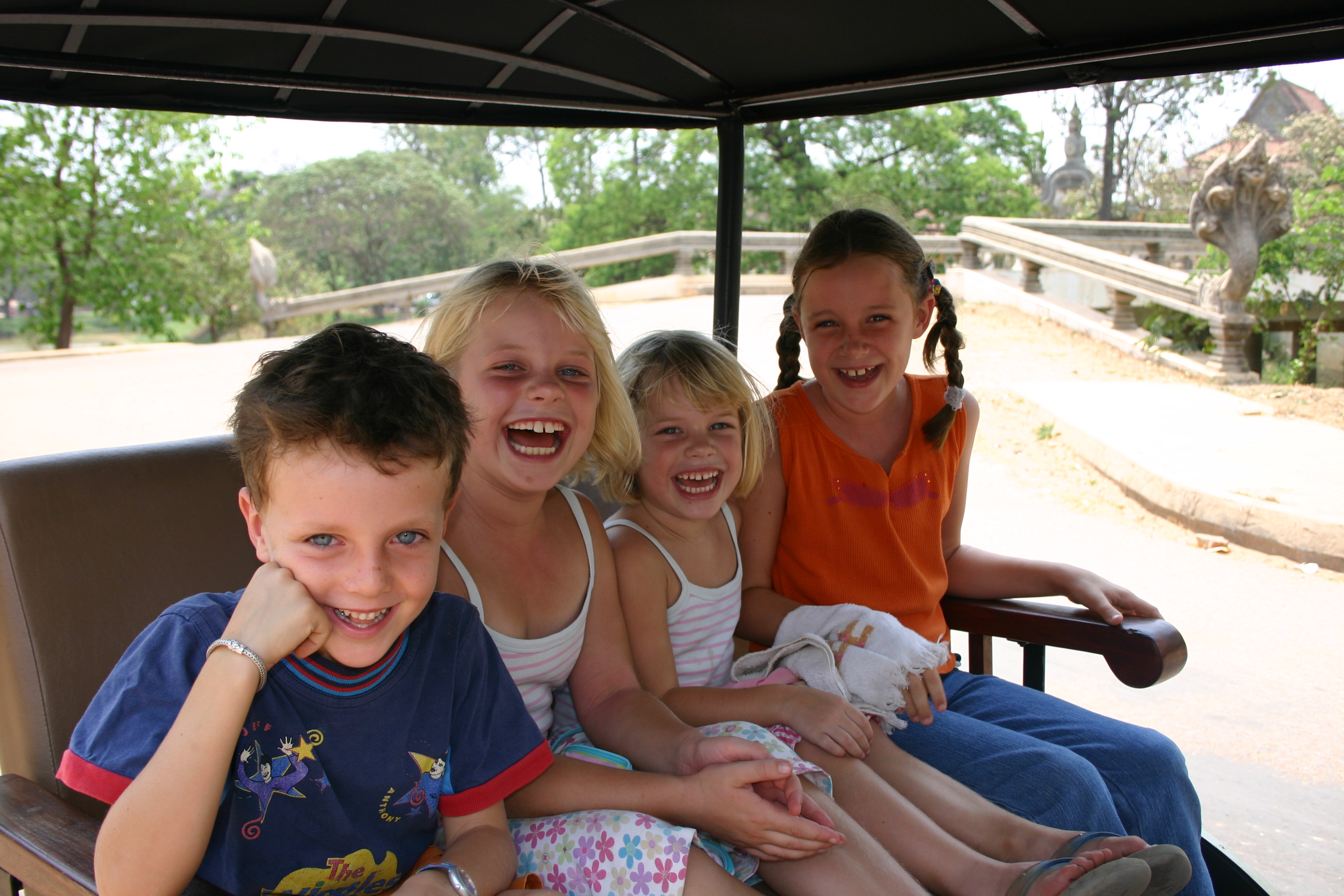
Cambodia
is a country with huge contrasts, as I've already said, and our afternoon
was a stark example of that. After spending the morning looking around
poverty-stricken villages, the girls were invited over to the exclusive
hotel for a swim with their new playmates. The hotel tuk-tuk picked
them up, and they all took off across town with Sarah, in high spirits.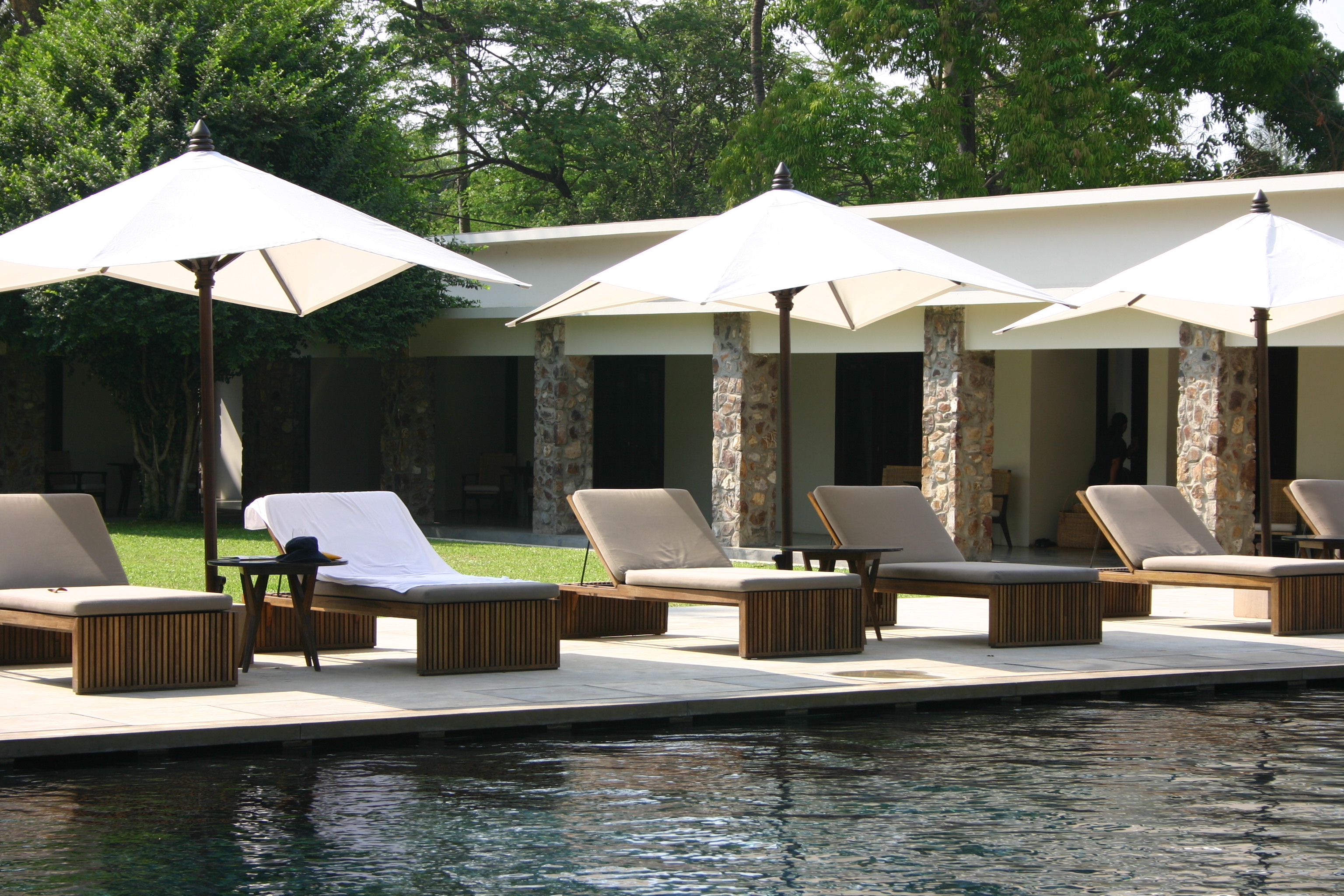 They
spent the afternoon in and around one of the most expensive hotels I
think I've experienced - $725 a night (no, not a typo)
buys you a haven of peace and quiet in the middle of the hustle, bustle
and building sites of Siem Reap. If you click on the picture on the
left, you'll see some views of the kind of luxury that money can buy,
and the serenity that it's possible to get even in the harshest of countries.
It is all very deliberately low-key - the hotel doesn't have a name
on the outside, and it isn't on any of the town maps, or the accommodation
advertising. Instead it just sits as a silent oasis. Although it took
us by surprise at first, it shouldn't have - after all it is the same
the world over. Step outside of the London Savoy in the evening, and
you have to walk around the homeless sleeping in shop doorways on The
Strand. We still remember the contrasts of luxurious hotels and slums
cheek-by-jowl in New Delhi. And I'm sure that the same contrast exists
in every city around the world. It is clearer to see, if no less easy
to understand, here in Cambodia. I wonder in a year's time, what the
children will remember of it?
They
spent the afternoon in and around one of the most expensive hotels I
think I've experienced - $725 a night (no, not a typo)
buys you a haven of peace and quiet in the middle of the hustle, bustle
and building sites of Siem Reap. If you click on the picture on the
left, you'll see some views of the kind of luxury that money can buy,
and the serenity that it's possible to get even in the harshest of countries.
It is all very deliberately low-key - the hotel doesn't have a name
on the outside, and it isn't on any of the town maps, or the accommodation
advertising. Instead it just sits as a silent oasis. Although it took
us by surprise at first, it shouldn't have - after all it is the same
the world over. Step outside of the London Savoy in the evening, and
you have to walk around the homeless sleeping in shop doorways on The
Strand. We still remember the contrasts of luxurious hotels and slums
cheek-by-jowl in New Delhi. And I'm sure that the same contrast exists
in every city around the world. It is clearer to see, if no less easy
to understand, here in Cambodia. I wonder in a year's time, what the
children will remember of it?